Key points
- A slow crank on the first start of the day is the earliest and most useful warning.
- The battery light on the dashboard is a charging system warning, so it points to the alternator first.
- A swollen, leaking or rotten-egg-smelling battery should not be jump-started.
- Start-stop that stays off for weeks is often the car protecting a weak battery.
- Several signs have more than one cause. Test the battery and the charging system before buying a new one.
Slow crank and clicking when you start
A slow crank is the earliest and most reliable warning. The engine turns over more lazily than usual, most noticeably on the first start of the day, then fires. It means the battery can no longer deliver its full cranking current. Many drivers ignore it for weeks because the car still starts, and then one morning it does not.
Rapid clicking with no crank usually means the battery has enough voltage to pull in the starter solenoid but not enough current to turn the engine. A single heavy click with bright dashboard lights points more towards the starter motor or its connections. Either way, stop after a few attempts, since repeated cranking drains what little charge is left.
Dim lights, the battery light and start-stop switching off
Headlights that dim noticeably at idle or when you press the window switch, a slow blower fan and a radio that resets its clock or presets all suggest low system voltage. On modern cars the electronics react first: warning messages appear, the infotainment screen restarts during cranking, or electric windows lose their one-touch setting.
The battery warning light on the dashboard is really a charging system light. If it stays on while driving, the alternator may not be charging, and the car is running on the battery alone. Switch off what you do not need and head somewhere safe to stop. Do not assume a new battery will cure it.
On cars with start-stop, the system switching itself off is often the first hint. The car monitors its battery through a sensor and disables start-stop when charge or condition drops below what it needs for a restart. Hot weather and heavy AC use can also pause it, so one day without start-stop means little, but weeks without it deserve a test.
Swollen case, rotten-egg smell and corrosion
Open the bonnet and look. A battery case that bulges at the sides or top has been overheated or overcharged, and it should be replaced, not jump-started. A rotten-egg (sulphur) smell means the battery is gassing heavily, often from overcharging or an internal fault. Keep sparks and flames away, and have the charging system checked too.
White, green or blue crust on the terminals is corrosion. It adds resistance, so a healthy battery can behave like a weak one. Cleaning and tightening the terminals sometimes restores normal starting. Heavy corrosion that returns quickly, or dampness around a terminal post, suggests the battery is leaking or venting and is near the end of its life.
Age as a warning sign
Age is a risk factor, not a verdict. UAE workshops commonly quote two to three years for a car battery in this climate, so one past its second summer deserves a yearly test even if it shows no symptoms. The date code on the label tells you when it was made. A battery that has been run flat several times ages faster.
Each sign, what it likely means and what to do
Use the table as a first guide, not a diagnosis. Two or three signs together make a battery fault more likely than any one alone. Signs that appear only while the engine is running point away from the battery and towards the charging system, and signs with bright, steady lights point towards the starter.
| Sign | Likely meaning | Action |
|---|---|---|
| Slow crank | Battery losing cranking power, sometimes poor connections | Book a battery test soon |
| Rapid clicking, no crank | Battery too low to turn the starter | Jump start, then test battery and charging |
| Single click, lights stay bright | Starter motor or its wiring more likely | Have the starter circuit checked |
| Dim lights, electronics resetting | Low system voltage | Test battery and alternator output |
| Battery light on while driving | Charging fault: alternator, belt or wiring | Cut electrical load, stop safely, test charging |
| Swollen case | Overheating or overcharging | Do not jump-start. Replace and check charging voltage |
| Rotten-egg smell | Battery gassing from overcharge or internal fault | Keep sparks away and call a technician |
| Corroded terminals | High resistance at the connection, possible leak | Clean and tighten, then test |
| Start-stop keeps switching off | Car protecting a low or ageing battery | Test. Fit AGM or EFB if it needs replacing |
| Battery over two years old | Higher risk in UAE heat | Test once a year |
Test before you replace
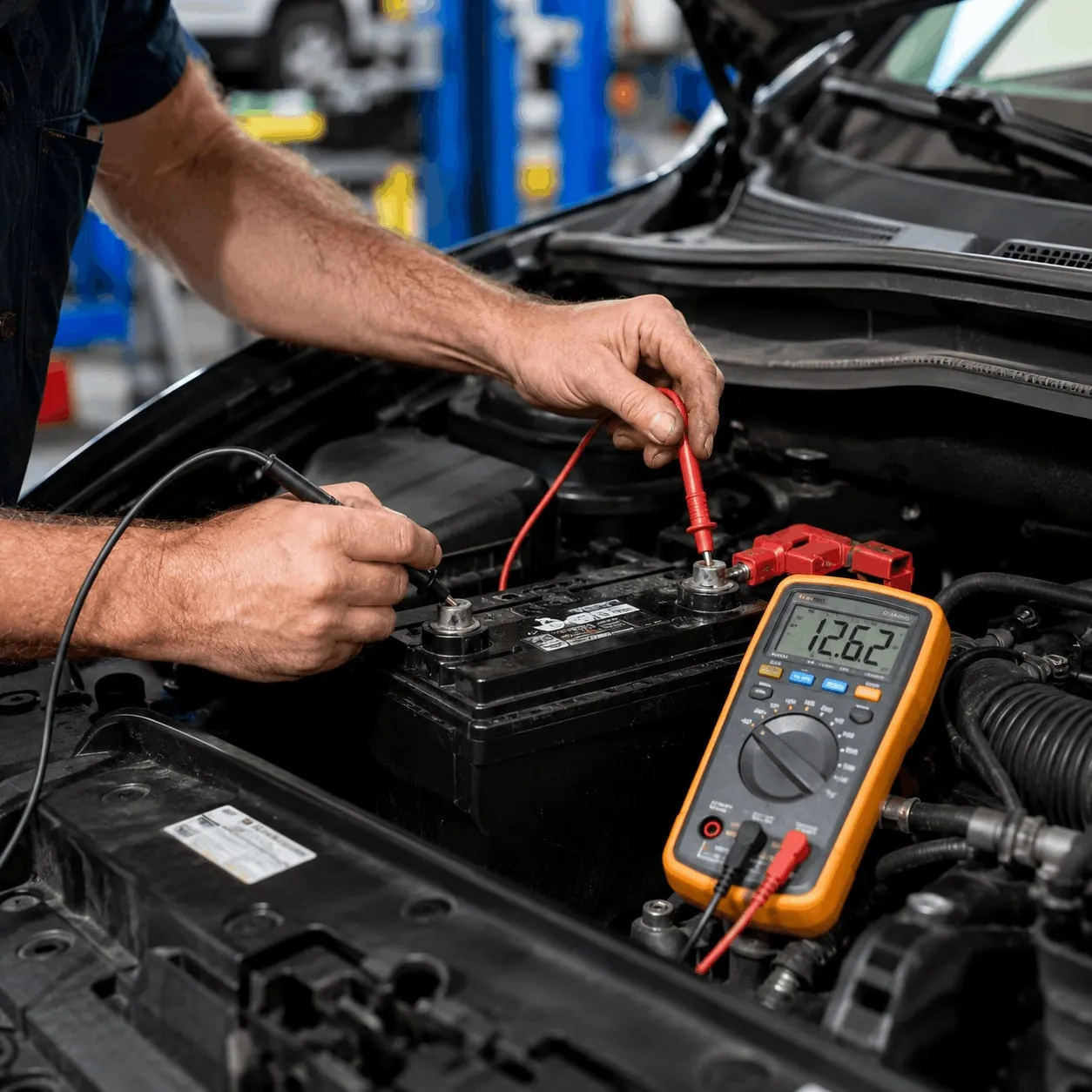
Several of these signs have more than one cause. A slow crank can come from a corroded cable or a tired starter. A flat battery can be the result of an alternator that is not charging or a drain while parked. A proper test measures the battery state of health, cranking performance and charging voltage, and takes a few minutes.
800MyBatt sends a technician to where the car is in Dubai, Abu Dhabi or Sharjah, at any hour. Send your location pin on WhatsApp with the car make, model and year. The technician tests first, then jump-starts or replaces the battery on the spot as the result requires. You get an arrival estimate before dispatch, based on location, traffic and access.
Reviewed by technicians who test and fit car batteries across the UAE every day.