Key points
- A map pin alone is not enough underground. The technician needs the building, tower, parking level and bay number.
- Tell building security in advance and be ready to meet the technician at the entrance with your access card.
- Automatic cars cannot be push-started, and a flat battery often leaves the car locked in Park with the parking brake on.
- The work is done in the bay: test, jump start or battery replacement, then a charging check.
Why a flat battery in a basement is different
On a street, a technician follows the map pin and parks next to you. Underground, the pin shows only the building, phone signal is often weak, there may be several towers sharing one podium, and a donor car can rarely get nose to nose with yours. Finding the car and getting equipment to it takes most of the time, so clear details matter.
Many service vans are also taller than the height limit at the ramp. The limit is posted on the bar at the entrance, and it varies from one building to the next. If the van cannot go down, the technician parks at ground level or in a loading bay and carries the equipment to your car, which is routine for a mobile battery replacement.
What to tell the technician
Go up to where your phone has signal and send everything in one WhatsApp message before the technician sets off. It saves calls that drop in the basement and lets the right battery be loaded before dispatch. If you can, add a photo of the battery label and a photo of the pillar or wall marking nearest to the car.
- Location pin, building name, and tower or block if there is more than one.
- Which entrance or ramp to use, and the street it is on.
- Parking level (for example P1 to P5, B2 or podium level) and the bay number.
- Visitor access: open barrier, ticket, intercom, security desk, or a resident who has to let the technician in.
- Height limit at the ramp if you know it, and whether there is visitor or loading parking at ground level.
- Car make, model and year, and whether it has start-stop.
- What happened: nothing at all, clicking, slow cranking, or dashboard lights on but no start.
- How the car is parked: nose in or reversed in, and how close it is to the wall or the next car.
Security, access cards and building rules
Residential and office towers control who goes down to the parking levels. Tell the security desk or building management that a battery technician is on the way and give them the company name. Some buildings ask for visitor registration or an ID at the desk. A few minutes of notice avoids a long wait at the barrier.
If the lifts or parking doors need an access card, meet the technician at the lobby or the ramp and go down together. Stay with the car while the work is done, since you will need to unlock it, open the bonnet or boot and start the engine. If you cannot be there, arrange for someone who has the key and the card.
Mall and airport car parks
Large mall car parks are divided into zones by colour, letter or number, and each pillar carries a code. Send the mall name, the zone, the level, the pillar code and the nearest mall entrance. A photo of the pillar is the quickest way. Mall security can usually guide the technician, so let them know as well.
At airports, send the terminal, the car park name, the level and the row. Batteries often fail here after the car has stood for days or weeks during a trip. The technician takes a ticket at the barrier like any other visitor. Call from the car once you have landed and collected your bags, not from the arrivals hall.
Electronic parking brakes and cars stuck in Park
With a flat battery, most modern automatics cannot be moved. The gear selector stays locked in Park because the shift lock needs power, and an electronic parking brake cannot be released by its switch. The steering lock may stay engaged too. So the car cannot simply be rolled out of the bay towards a donor car or a recovery truck.
Many cars have a manual shift-lock release described in the owner manual, but there is rarely a reason to use it. Once a booster is connected, the car has power again and everything releases normally. If the battery is in the boot and the electric boot release is dead, the technician powers the car through the jump posts under the bonnet first.
Why push-starting is not an option for automatics
Push-starting works only on a manual gearbox, where the clutch links the wheels directly to the engine. A conventional automatic needs hydraulic pressure from a pump that only turns when the engine is running, so rolling the car does not turn the engine. Almost every car in UAE basements is an automatic, so pushing achieves nothing.
It is also unsafe. With the engine off there is no power steering and little brake assistance, and basement ramps are steep with pillars close by. Even on a manual car, a completely flat battery cannot power the fuel pump and engine electronics, so a push start may still fail. A booster is the correct tool.
What the technician carries down
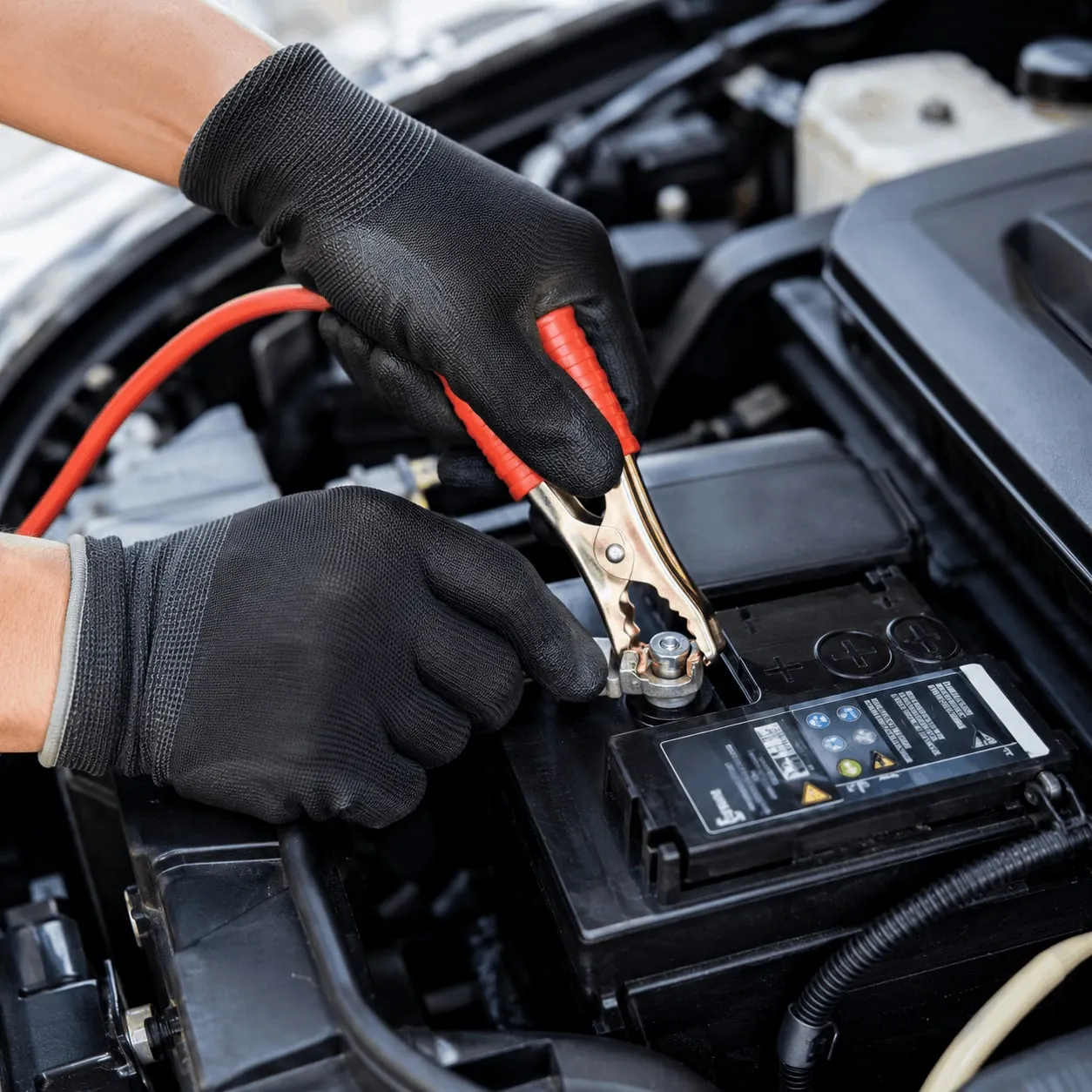
The technician brings a portable booster, a digital battery tester, hand tools and, if a replacement is likely, the battery matched to your car. The test comes first. If the battery is healthy but discharged, a jump start is enough. If it fails the test, it is replaced in the bay and the old one is taken away.
After fitting, the charging system is checked with the engine running, and cars that need it have the new battery registered. If the test points to a fault elsewhere, such as the alternator or the starter, you are told so. 800MyBatt works 24/7 in Dubai, Abu Dhabi and Sharjah, and gives an arrival estimate before dispatch.
Reviewed by technicians who test and fit car batteries across the UAE every day.